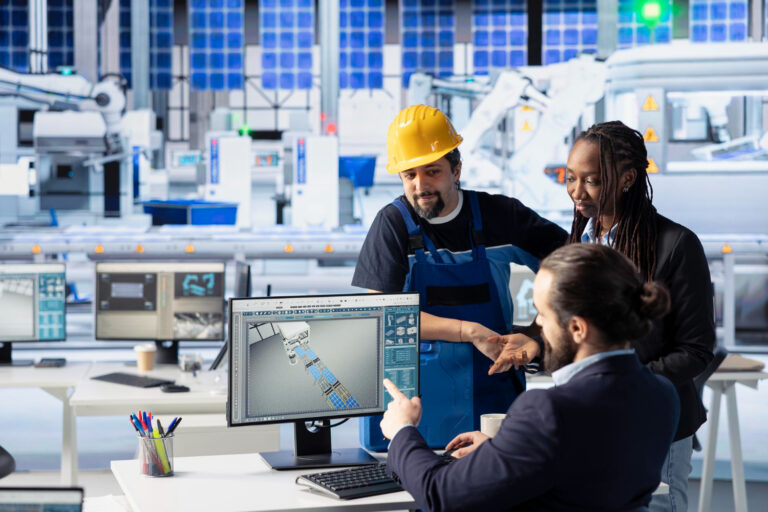

Manufacturers looking to improve efficiency and dependability in the industrial machinery sector must comprehend the significance of OEM supply chain providers. High-performance production lines and automation procedures are made possible by the specialized parts, subsystems, and fully integrated systems that industrial machinery OEMs design and offer. In a variety of manufacturing applications, their work promotes creativity, accuracy, and long-term operational stability. In order to provide decision-makers with the information they need to select the best OEM partnerships for optimal production results.
What does “OEM company” mean?
A company that manufactures parts or equipment that are incorporated into the final products of another manufacturer is known as an Original Equipment Manufacturer (OEM). OEMs are vital to the supply chain because they provide the parts needed to assemble completed goods. OEMs can specialize in producing particular components thanks to this partnership, freeing up other businesses to concentrate on product ownership, branding, and market strategy.
OEMs are important in a number of industries, such as:
- Vehicle: OEMs supply vital parts including engines, transmissions, and electronic systems to the vehicle industry. Their knowledge enhances the performance and safety of vehicles.
- Electronics: OEMs produce essential parts for consumer electronics and industrial uses, such as circuit boards and screens.
- Medical equipment: OEMs in the medical industry provide parts that adhere to strict regulations, guaranteeing the effectiveness and safety of medical equipment.
- Industrial Machinery: OEMs provide parts including actuators, control panels, automation systems, and power units in this industry. Their products improve equipment dependability, accuracy, and production efficiency in all manufacturing processes.
Through economies of scale and specialized production skills, OEMs not only improve product quality but also help reduce costs. In order to enhance production processes and eventually drive hard-dollar ROI, OEMs also use vendor-neutral consulting methodologies, integrating their own automation engineers and relocation-incentive specialists within teams.
What is OEM Vendor
A business that manufactures systems, parts, or components utilized in the finished goods of another business is known as an OEM (Original Equipment Manufacturer) vendor. They frequently operate B2B to sell essential, high-quality components for industries including automotive, technology, and industrial, with a focus on manufacturing to unique customer designs.

OEM Vendor Usage Examples:
- Automotive Industry: A tire producer (like Michelin) serving as an OEM supplier, making tires for a car manufacturer (like Ford).
- Technology/Computing: A business such as Foxconn produces parts for Apple’s iPhones.
- Software: Microsoft provides Dell with Windows to pre-install on PCs.
- Industrial Machinery: Specialized companies that provide engines for manufacturers of construction equipment.
Features of OEM Vendors/Suppliers
OEM suppliers are unique in a number of ways that make them essential to numerous industries:
- Custom Manufacturing: OEM providers make parts according to the precise guidelines supplied by the original manufacturer, guaranteeing that every component fits flawlessly into the finished product.
- Quality assurance: Because the reputation of the final product is directly impacted by the effectiveness of their parts, these suppliers adhere to stringent requirements to offer high-quality products.
- Intellectual property: OEM suppliers frequently work with original equipment manufacturers on internal components and product development, occasionally exchanging intellectual property to improve the production process.
Advantages of Dealing with OEM Vendors/suppliers
There are a number of benefits to working with OEM suppliers that may keep your business productive, creative, and on the cutting edge. Your vendor manager can maintain the competitiveness of your products by streamlining procedures and cutting expenses through tight collaboration with these suppliers. Among the main advantages are:
Inventiveness: These suppliers frequently offer cutting-edge concepts and technical developments that raise the caliber and usefulness of your goods. Working with these vendors gives you access to state-of-the-art technology and real-world knowledge that helps your business stay ahead of consumer expectations and market trends.
Cost-Effectiveness: Your company can save production costs by utilizing the knowledge and production capabilities of specialized suppliers. These vendors frequently specialize in large-scale production of high-quality components, freeing you up to concentrate on higher-value tasks without the extra worries associated with internal production.
Time savings: By simplifying the production process, these providers can aid in accelerating the time to market. They can swiftly produce and distribute components thanks to their specialized facilities and production lines, which expedites the process of getting finished goods into your consumers’ hands.
Adaptability: It can be challenging to convince a huge corporation to make even minor adjustments to your order, as anyone who has ever worked with one will attest. They frequently have rigid policies and processes that make it challenging to complete tasks.
Working with an OEM can therefore be a welcome change of pace. They are aware that every company is distinct and has particular requirements.
They are therefore prepared to collaborate with you to develop a solution that is especially suited to your requirements. If your production process is complicated or you need to modify your order at the last minute, this can be a big help.
You won’t ever have to worry about having to adhere to strict regulations or being forced into contract manufacturing. You can always find the adaptable solution you require when working with an OEM.
Scale: Working with an OEM has several benefits, one of which is that they can scale up or down to meet your demands. This implies that they can handle big orders for well-established companies and small orders for startups.
This allows you to expand your company without having to worry about whether your OEM partner can keep up. Working with an OEM has additional benefits because they typically have extensive industry experience.
They can assist you in troubleshooting any issues that may develop throughout the manufacturing process and finding solutions because they are well-versed in mass production.
Additionally, because of their knowledge, they can typically provide guidance on how to make your product assembly better overall.
Lastly, because OEMs frequently have connections with suppliers and can obtain discounts that you wouldn’t be able to obtain on your own, cooperating with them can save you money.
For your long-term manufacturing success, an OEM is a good choice if you’re searching for a manufacturing partner that provides a China product assembly service.
Risk Mitigation: You can lower the risk associated with launching a new product by collaborating with an OEM. They have a great deal of design and production process experience.
They will be able to see such concerns early on and come up with fixes before they worsen. In the future, this can save you a great deal of time, money, and problems.
For instance, if there are problems with your product’s design, they can collaborate with you to discover a solution that satisfies your requirements and guarantees that the finished product is of the highest caliber.
Additionally, OEMs will be able to negotiate the best price for your components because they have established ties with suppliers. This can lower your overall expenses and increase your profit margins.
Lastly, you will have access to an OEM’s customer service and technical support teams if you collaborate with them. If you have any issues following the introduction of your product, this can be quite beneficial.
To put it briefly, working with an OEM can help you steer clear of a lot of the dangers involved in launching a new product.
Enhanced Quality Assurance: For any company that produces goods, quality control is crucial. Product flaws or poor quality might result in unhappy customers and even legal issues.
Working with a seasoned Original Equipment Manufacturer (OEM) can assist you in creating a quality control system that will guarantee your items fulfill your requirements before they are shipped from the plant.
OEMs are manufacturing experts, so they understand every aspect of the production process and are able to spot possible problems that could result in flawed or inferior products.
You can prevent future expensive issues by putting in place a robust quality control system. In the long run, working with an OEM from the beginning can save you headaches, money, and time.
Eco-Friendly: Original equipment manufacturers (OEMs) have grown in popularity as companies search for solutions to lessen their environmental effect.
Because they utilize less resources and generate less trash, OEMs are generally more ecologically responsible than other companies. Furthermore, compared to other companies, OEMs usually have a less carbon footprint.
Therefore, selecting an OEM might be a wonderful method for companies to lessen their influence on the environment.
When selecting an OEM, there are many things to take into account, but the possible environmental advantages should undoubtedly be one of them.
Increased Client Contentment: Every business owner understands that long-term success depends on satisfied customers. After all, satisfied clients are more likely to return and do business with you again.
Working with an OEM can assist you make sure that your items either meet or surpass your consumers’ expectations because they are committed to quality control. Over time, you might observe an increase in client satisfaction.
Additionally, this may result in increased client loyalty and repeat business. Therefore, collaborating with an OEM can be the best option if you’re trying to improve client happiness.
Financial Gains: Supporting local businesses is more crucial than ever during these challenging economic times. Another advantage of working with an OEM partner is this.
In addition to receiving top-notch goods and services, working with an OEM boosts the local economy and creates jobs.
The community as a whole may benefit from this, increasing its appeal to other companies.
Therefore, keep in mind how important it is to support your local economy while you’re searching for a partner to help satisfy your needs. Everyone benefits when they collaborate with an OEM.
Participation in the Community: Furthermore, OEMs are frequently well-represented in their local communities. This can help your company in many ways, including by giving you access to a trained workforce, networking possibilities, and a positive reputation.
OEMs are a significant component of the world economy and are essential to numerous industries, including as electronics, computers, and automobiles. Working with an OEM has several advantages.
These include things like R&D resources, economies of scale, and access to trained personnel. Furthermore, OEMs are frequently well-represented in their local communities. There are several ways in which this might help your company.
Participating in the community, for instance, can help you build a positive reputation. Being connected to a reputable organization might have a good effect on you.
Participating in the community might also provide you with access to a skilled labor force. Working with an OEM may give you first dibs on the best applicants, as local talent is always in demand.
Lastly, being active in the community opens up a lot of networking chances. You’ll make new acquaintances and create connections that may help your company.
In general, working with an OEM has many benefits. Make sure to take their degree of community involvement into account when selecting an OEM partner. It could have a significant impact on your company.
Why Is OEM Manufacturing in India Important?
India’s manufacturing capacity has significantly changed over the past ten years, making it a desirable location for businesses looking for OEM production capabilities.
India’s OEM manufacturing sector is expanding quickly for the following reasons:
- Manufacturing is receiving more attention because to the Make in India campaign.
- There is a plenty of skilled, reasonably priced labor accessible.
- Increased demand from the FMCG, pharmaceutical, electronics, and automobile industries.
- Geographical strategy for integrated domestic and global supply chains.
- Active governments prioritize infrastructural support and manufacturing industry clusters.
OEM manufacturing in India is attracting an increasing number of domestic and foreign firms.
Comprehending the OEM Supply Chain
Comprehending the OEM supply chain is essential to comprehending how OEM operations become efficient and scalable.
The supply chain consists of:
- Suppliers of raw materials: the initial source of inputs used in production
- Suppliers of parts and components
- Manufacturing Units: Testing, assembly, and OEM production
- Logistics and warehousing: inventory, delivery, and distribution
OEM vendor
Establishing a recognized manufacturing firm, obtaining GST/PAN registration, and gaining quality certifications like ISO or BIS are all necessary to become an OEM (Original Equipment Manufacturer) provider in India. Important procedures include enrolling on the Government e-Marketplace (GeM) portal, going through a vendor evaluation, and presenting documentation of trademark or brand ownership.
Crucial Steps for OEM Vendor Status
- Create a Legal Organization: For benefits, make sure your company is a registered manufacturer with a current PAN, GSTIN, and, ideally, Udyam/MSME registration.
- Obtain Certifications of Quality: To guarantee product compliance, acquire pertinent quality standards, such as ISO or BIS.
- Register on the GeM Portal: Choose the OEM registration option after creating a seller account on the GeM portal.
- Give Ownership of the Brand: Provide evidence of ownership, such as a letter from an authorized distributor or a trademark certificate.
- Vendor evaluation (VA): To confirm manufacturing capabilities, do a vendor evaluation (which is required for non-MSMEs or those with revenue under ₹500 crore).
- Submission of Documents: Send in all required paperwork for verification, such as product specs and production licenses.
Industrial and Governmental Requirements
The main platform for government procurement is the GeM Portal. It necessitates thorough, methodical verification.
Technical Evaluation: Products may need to be tested at approved facilities by manufacturers.
Compliance & Standards: Depending on the industry, adherence to standards like CE or RoHS may be necessary. The majority of OEMs need to hold an ISO 9001:2015 certification. Electronics and machinery frequently need sector-specific marking like BIS or ISI.
Advantages and Advice
- Scalability: Production may be scaled to meet demand thanks to OEM relationships.
- Market Entry: This position gives you direct access to large-scale purchases, especially from the government.
- Preparation: To guarantee a seamless application procedure, keep accurate and current documentation.
Conclusion
For enterprises wishing to take part in government procurement and major industrial supply chains, being an OEM vendor in India might present substantial growth prospects. Businesses may now more easily engage with big customers in industries like automotive, electronics, industrial machinery, and healthcare thanks to programs like Make in India and digital procurement platforms like the Government e-Marketplace (GeM).
However, production capacity alone is not enough to succeed as an OEM provider. Businesses need to make sure they are properly registered, comply with GST and PAN, have quality certifications like ISO or BIS, and have an orderly documentation structure. For long-term reputation and cooperation chances, it is essential to comprehend the OEM supply chain, uphold stringent quality standards, and finish the necessary vendor evaluation procedure.
Being an OEM vendor for Indian manufacturers involves more than just providing parts; it also entails creating dependable, scalable, and innovative alliances that sustain contemporary production environments. Businesses can effectively establish themselves as reliable OEM partners and gain access to high-value industrial and government procurement sectors by adhering to the proper registration procedure, fulfilling compliance standards, and investing in high-quality manufacturing.