
The field of procurement is at a turning point. Cost containment, supplier sourcing, contract negotiations, and quality assurance are examples of well-known procedures that procurement teams have long since perfected. An unfamiliar country lies on the other side.
Procurement teams now have to strike a balance between supply shortage concerns, new regulations, sustainability objectives, and cost control. The biggest change, though, is probably the introduction of AI, which is changing long-standing procedures and habits and creating exciting new prospects.
Types of AI for Procurement
These days, procurement uses five primary forms of AI:
Any software or algorithm that can be deemed “smart” is considered artificial intelligence (AI). As a branch of artificial intelligence, machine learning (ML) algorithms can identify patterns in datasets and apply them to forecasting, prediction, and decision-making.
Algorithms that imitate human behavior to perform repetitive tasks are known as robotic process automation (RPA). Although AI can power RPA, it is not officially regarded as a form of AI.
Chatbots, copilots, and virtual assistants are examples of algorithms that use natural language processing (NLP) to comprehend, interpret, and produce human language. Algorithms that can identify and extract text from photographs and scanned documents, such as paper-based bills, are known as optical character recognition (OCR).
Using Generative AI for Procurement
Generative AI has become a major topic in boardrooms worldwide since ChatGPT went live in late 2022.
Generative AI has the potential to upend entire sectors and enterprises with its capacity to produce new content through a straightforward user interface. It is beginning to be used by certain progressive procurement teams to produce RFP documents, develop completely new procedures, and independently shortlist providers. Although it is still in its early stages, generative AI in procurement has immense potential.
AI in Procurement Use Cases
There is a lot of demand on procurement to reduce costs, reduce risk, enhance sustainability, and take on a more strategic position in the company. Teams must be extremely agile in order to achieve these objectives and keep up with the quick speed of change. They must also become less reactive and more proactive in all they do. AI is assisting in a few crucial procurement sectors.
Invest in Categorization and Evaluation
With almost flawless accuracy, spend categorization algorithms can quickly search through line items and select buzzwords to tie to spend categories. Additionally, teams may proactively find cost-saving opportunities with AI-powered spend analysis, which can serve as the foundation for improved sourcing, category, and spend management strategies.
Worldwide Sourcing Approach
Machine learning algorithms are capable of identifying changes in supply trends, forecasting future developments, and assisting in the formulation of global sourcing strategies through the analysis of massive global datasets.
Guided Purchasing
AI-assisted item recommendations allow the procurement department to provide customized assistance, encourage spending within the company’s catalogue to prevent needless expenses, and combine procurement policies to make it easy for customers to locate what they’re searching for. Additionally, it incorporates useful safeguards and offers rapid access to chosen vendors.
Supplier Administration and Intelligent Procurement
To suggest the best vendors for particular requirements, AI-powered software can examine supplier databases, market trends, historical data, ESG reports, and other elements. Additionally, it can offer a thorough understanding of a business’s supply chain, enhancing supplier performance and advancing strategic objectives.
RFX Production
Requests for proposals (RFPs), requests for quotations (RFQs), and other RF documents, including supplier lists and critical questions, can be automatically created by AI.
Risk Management for Suppliers
AI systems are able to quickly identify abrupt changes with a vendor or supplier and evaluate how such changes may affect risk. Additionally, they have the ability to mine millions of data sources to warn businesses about possible supply chain risks.
Conformity
Businesses may automatically analyze payment terms, remove duplication, and spot non-compliance by utilizing AI to organize contract, invoice, and PO data.
Retrieval of Data
Natural language processing may retrieve information from bills and agreements to detect fraud and risk, give more insight into company spending, and expedite entire procedures. In order to identify opportunities and risks, NLP can also gather data from other sources, like market metrics, company credit assessments, social media, and publicly accessible supplier information. Through a technique known as text parsing, natural language processing has made it possible for procurement to mine contracts for important information. Parsing algorithms can be used by contract management software to quickly scan and analyze even massive volumes of contracts for important information. To go one step further, optical character recognition (OCR) is an AI-enabled method that automatically recognizes and analyzes text from any image, including pictures of scanned contracts that have not yet been digitized.
AI algorithms and software are far more adept than human language at deciphering numerical data. A straightforward comparison is that people think in terms of words, whereas computers think in terms of binary systems (ones and zeroes). Word embedding is a type of natural language processing (NLP) in which vocabulary words and phrases are mapped according to their similarity and relationship to other words. When analyzing text fields in purchase orders, word embedding can help procurement find groupings of purchased items that fall into a similar category or subcategory.
Among the most discussed uses of AI that depend on natural language generation (NLG) are chatbots and personal assistants. By first analyzing human input and then providing a written narrative response, these advances natural language processing. NLG is now restricted in procurement to pre-configured chatbots or virtual assistants that perform very specific tasks, even though voice-based assistants like Siri or Alexa are already widely utilized in consumer applications.
Management of Contract Lifecycles
Artificial intelligence (AI) systems can automatically produce initial versions of contracts, facilitate negotiations, and identify possible hazards in contract wording. In order to guarantee compliance, they might also keep an eye on deadlines and terms and conditions.
AP Digitization
By removing manual duties from accounts payable procedures, intelligent RPA can expedite the processing and approval of invoices, increase accuracy, and guarantee compliance. In order to streamline the process and digitize papers, optical character recognition can read important information from paper-based invoices.
An Explanation of Cognitive Procurement
The process of using self-learning AI algorithms to imitate human intellect is known as cognitive procurement. Automated data mining, machine learning, pattern recognition, and natural language processing are some of these self-learning AI methods. The term “cognitive procurement” comes from “cognitive computing,” a new area of sophisticated computer science.
Any technology or software that simulates how the human brain works and enhances decision-making is referred to as cognitive computing (CC). It simulates how the human brain perceives, makes sense of, and reacts to stimuli in order to solve particular problems or tasks.
Cognitive analytics (CA) is one way that cognitive computing and procurement are related. By simulating the human brain’s capacity to see patterns and make inferences from data, CA offers a novel method for producing insights from massive volumes of structured or unstructured data. Not all AI-assisted analytics solutions use cognitive solutions, even if cognitive analytics may be able to address many procurement analytics problems.
Cognitive computing can also help procurement by supporting sourcing procedures. Buyers and procurement teams can find new opportunities or automate non-strategic sourcing tasks with the aid of cognitive sourcing. Chatbots and other sourcing helpers are instances of cognitive sourcing.
Since cognitive computing is still in its infancy, care should be taken. Fundamental definitions and the characterization of “cognitive” processes in a corporate setting are still up for debate. Simultaneously, a lot of software solutions are being given with the promise of embedded intelligence similar to that of a human. It is advised to verify assumptions in cognitive procurement with internal or external information systems professionals, notwithstanding the rapid advancement of technology.
Procurement AI Examples
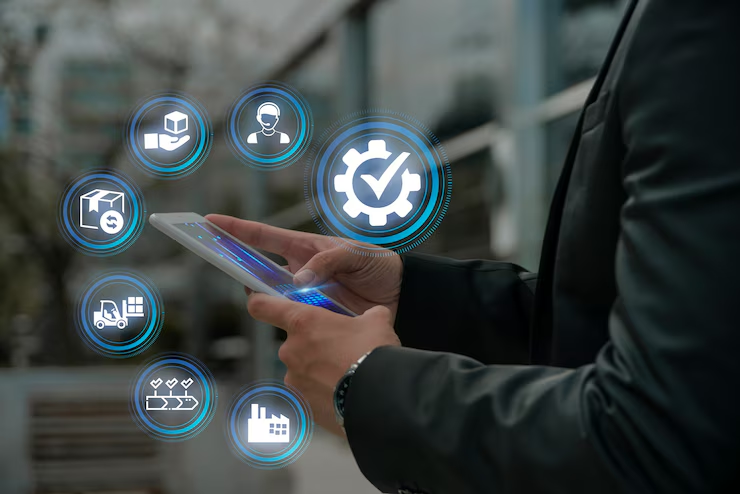
There are more and more instances of AI being applied in procurement operations, even though its acceptance in commercial applications is still in its early stages. Spend analysis makes extensive use of machine-learning algorithms to enhance and expedite several procedures, such as vendor matching and automatic spend classification, with much more to come.
Segmentation of Machine Learning Spending
Techniques for classifying spending include: Supervised learning in spend categorization eliminates the tedious task of repeatedly classifying fresh spending by having humans train algorithms to identify patterns in spending. When algorithms are designed to find novel and intriguing patterns in vendor connections without human assistance or involvement, this is known as unsupervised learning in vendor matching. For better visibility and data coherence, machine learning algorithms can readily combine DHL, DHL Freight, Deutschland DHL, and DHL Express into a single entity.
Classification Reinforcement Learning is a technique in which algorithms’ classification decisions are evaluated by humans and either rewarded or penalized based on the outcomes.
But remember that 100% automation isn’t always feasible when developing a business case for AI. Typically, 80% of a process (such as spend classification) can be automated, but the other 20% might need human intervention. When estimating how long an AI-driven process will take and how it will enhance existing timescales, apply this 80/20 guideline.
Gathering Market or Supplier Information
Look for and collect information on suppliers or certain marketplaces using methods like natural language processing. For instance, monitoring social media platforms for clues regarding the risk postures of suppliers. AI has the potential to enhance forecasts for things like prices, maintenance requirements, and stock market trends.
AI can be used to leverage new data sources. Market indices, corporate credit ratings, and publicly accessible supplier data are examples of so-called “external” data sources. Large volumes of external data can be sorted through by AI-powered techniques to find possibilities and offer benchmarks and suggestions for enhancing performance.
Consider the task of comparing your performance to that of others. Let’s say you now benchmark your performance mostly utilizing internal data and a static historical data set. In this manner, you might obtain a reasonably accurate image, but you will still be missing certain important details. When external data, like stock prices and market news, joins the area, a whole new level of understanding is involved.
Identification of Anomalies
Although it may seem unattainable, automated alerts about anomalies, fresh opportunities, and suggested actions could soon be available in your procurement dashboards. AI is able to stay current with the most recent advancements and modifications in the operational environment since it processes an ever-increasing volume of data.
This will make it possible to quickly and more precisely identify any irregularities or changes. If something unusual has happened, AI will be able to alert the team right away and provide quick recommendations for possible solutions.
Using the data it has access to, it may also present potential simulations for various scenarios and new opportunities. In the end, human procurement professionals will have a better understanding of the situation and be able to act more quickly.
Furthermore, customers may be confident that AI’s recommendations are grounded in actual data rather than conjecture or speculation. This eliminates confusion and helps procurement leaders make better decisions by giving them the assurance that their choices are supported by actual data.
Companies Using AI for Procurement
Large corporations like PepsiCo, Siemens Energy, and Cisco, as well as IT giants like SAP, Oracle, Coupa, and IBM, are among the many businesses that use AI for procurement. These businesses employ AI to automate processes such as contract analysis, spend management, risk analysis, and supplier finding.
Examples of Enterprises Using AI Software for Procurement
PepsiCo: Using AI to find and better manage its supplier network.
Unilever: AI was used to assist in finding suppliers.
Siemens Energy: Uses AI to find smart suppliers for strategic growth.
Cisco: Uses AI, including supplier finding, to maintain a competitive edge.
BT Group: Uses AI in procurement methods to obtain a competitive advantage.
Amazon: Makes use of AI and machine learning in warehouse operations, including robotics for picking and sorting, and adaptive machines for real-time inventory and demand adjustments.
Suppliers of AI Technology
Accenture: Provides procurement solutions driven by AI.
Coupa: Offers an AI-powered suite for procurement and spend management.
SAP: Uses Joule Copilot and other AI-powered tools to manage contracts, spend, and suppliers.
Oracle: Integrates generative AI for sourcing, supplier management, and analytics into its Fusion Cloud Procurement system.
IBM: Provides AI-driven systems for supply chain risk management and procurement, such as Sterling Supply Chain Intelligence.
Zycus: Automates contracts and analyzes risks using generative AI.
GEP: Offers AI-first procurement solutions, such as GEP Quantum, to help with process improvement and decision-making.
Ivalua: Provides supplier management and procurement solutions driven by AI.
JAGGAER: Uses generative and artificial intelligence to manage suppliers and spending.
Basware: Automates fraud detection and invoice processing using AI.
Celonis: Uses generative AI in procurement to automate and mine processes.
Tonkean: Focuses on AI-driven procurement tools to optimize workflows.
Zip: Provides AI sourcing and procurement solutions.
Fairmarkit: Identifies and sources purchases on its own using artificial intelligence.
Workwise: Workwise is a cutting-edge AI-powered technology company that specializes in vendor management, digital procurement, and workflow automation for contemporary companies. Its platform makes it easier to create RFQs, communicate with vendors, evaluate quotes, and make purchases by using clever algorithms. Workwise helps businesses decrease manual labor, increase accuracy, and speed up procurement cycles by fusing AI-driven insights with intuitive tools. Workwise enables teams to operate more quickly and effectively with its real-time analytics, intelligent alerts, and smooth communication capabilities. It is intended to make traditional procurement a more efficient, data-driven process.
Future of Procurement in the Era of AI

Although nobody can accurately predict where we will be in ten to twenty years, certain judgments about what will be feasible for AI and procurement in the near future can be made. The analyst community is mostly in agreement that the current applications will continue to evolve in the future.
Processing payments and invoices, issuing and receiving orders, and controlling demand for purchases are all very simple processes to automate, according to McKinsey. Actually, a lot of them already are. However, it is more challenging to automate processes like vendor management and selection and negotiation. Don’t anticipate automating every activity in the near future, even though we will see a lot more automation of basic chores.
Although it’s impossible to foresee where procurement AI will ultimately lead us, we have produced some estimates about the potential level of maturity AI could reach:
Complete Process Automation: Operational procurement, including regular procedures, approvals, compliance, and reporting, will not require human intervention.
Automated Value Creation: Without human input, machines may be able to decide and act on opportunities for savings and value creation.
Complete Spend Transparency: All procurement-related expenditures might be utilized and made available to important stakeholders at any time, error-free.
Agile Supplier Ecosystems: Since data may move freely across partner systems, managing strategic supplier relationships will take on a whole new level.
AI will use data from the entire ecosystem, not just the data of a single individual, to make recommendations and take action. Although these scenarios are speculative, they might represent the pinnacle of existing AI uses.
The ability of procurement to produce quantifiable corporate value will determine its future. The goal of procurement transformation is to optimize ROI (return on investment) in terms of:
- Financial savings
- Effectiveness
- Cooperation
- Inventiveness
- Sustainability
- Monetary prosperity
In Conclusion
The rapid growth of artificial intelligence is transforming procurement beyond traditional cost control, supplier negotiations, and compliance. As organizations seek greater resilience, sustainability, and strategic value, AI enables procurement to shift from a reactive role to a proactive, intelligence-driven function. Automated spend classification, supplier discovery, real-time risk monitoring, contract analytics, and cognitive decision-making are reshaping every stage of the procurement lifecycle.
Although full automation of procurement is a long-term goal, current advancements show significant potential. Companies adopting AI-driven tools now will achieve greater visibility, faster processes, stronger supplier networks, and more reliable insights. The future of procurement will favor teams that use data, automation, and intelligent technologies to deliver measurable business value through cost savings, efficiency, innovation, and sustainable growth. As AI evolves, procurement is set to become one of the most strategic and future-ready enterprise functions